Perry Rhodan Arkon System Art: What Sets It Apart?
Searching for Perry Rhodan Arkon System Art can leave you with striking pictures but little reliable context. Mix up the planets, overlook the story’s date, or mistake fan art for an official cover, and the image tells the wrong story. This guide helps you recognize the setting, check artist credits, compare visual approaches, and plan artwork that respects the source while leaving room for your imagination.
What Is Perry Rhodan Arkon System Art?
Perry Rhodan Arkon System Art is a descriptive label for images of the fictional Arkon star system and its surroundings in the Perry Rhodan universe. It can include published covers, star maps, technical illustrations, planetary scenes, and independent fan interpretations. Here, the phrase describes a subject, not one particular painting or official product.
The subject combines space adventure with the visual identity of an interstellar civilization. Its most useful starting points are the Arkon worlds, their different purposes, and their place within the star cluster called Thantur-Lok in the stories.
Before judging an image, decide what it tries to do:
- A cover draws attention and suggests a story.
- A system map explains locations and orbital relationships.
- A technical illustration explains how an imagined structure works.
- An environment painting lets you experience a place.
- Fan art offers an independent interpretation of the setting.
These categories can overlap, but they do not promise the same kind of accuracy. A dramatic cover does not automatically function as a reliable system diagram.
Where Does Arkon Belong in the Perry Rhodan Universe?
Arkon belongs to the fictional civilization of the Arkonides. Michael Thiesen’s published series data sheet, “Thantur-Lok (M 13),” places the system within the star cluster associated with the Great Empire and its successor, the Crystal Empire. It also identifies the three principal Arkon worlds and their roles. See Source 1.
M 13 is a real astronomical object, while Arkon’s inhabited worlds and imperial history belong to fiction. Keep that boundary clear when describing a picture: a fictional star chart does not establish current astronomical measurements.
For Perry Rhodan Arkon System Art, location provides more than a background name. It gives an artist a reason to consider a crowded star field, long-distance travel, imperial reach, and the relationship between a capital system and its wider territory.
A useful caption separates those layers. “An imagined view of the fictional Arkon system in Thantur-Lok” describes the subject without presenting the scene as a telescope image or scientific reconstruction.
Why Are the Three Arkon Worlds So Important?
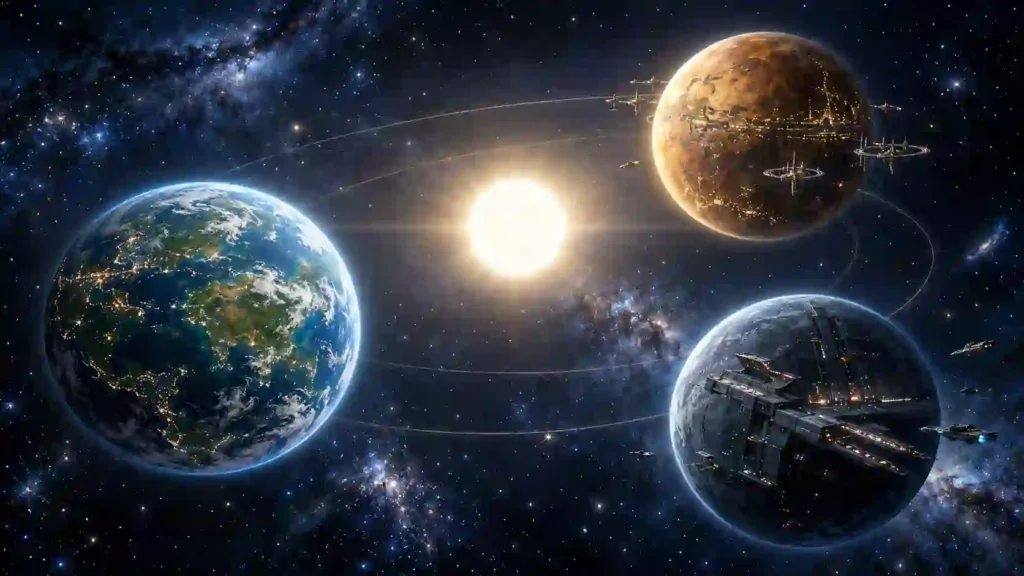
The classic three-world arrangement gives Arkon a clear visual identity. Arkon I, Arkon II, and Arkon III share a common orbit in the familiar configuration, rather than occupying three separate orbital tracks. The setting calls this grouping Tiga Ranton, or “Three Worlds.”
The worlds form a triangle around their sun in this arrangement. For a simple explanatory diagram, place the sun at the center of a circle and distribute the three worlds evenly around that circle.
Their different roles matter just as much as their positions:
- Arkon I: residential life and the Crystal World identity.
- Arkon II: trade and commerce.
- Arkon III: military power and war production.
Source 1 confirms the shared orbit and those broad roles. It also records a major historical change affecting Arkon III, so the familiar arrangement does not describe every point in the fictional timeline.
Think of the three worlds as three answers to a design question: where does this civilization live, exchange goods, and build military strength? That distinction can guide a scene even when the artist shows only one planet.
Which Subjects Belong in a Detailed Arkon Art Reference?
Use this table to organize Perry Rhodan Arkon System Art by subject, purpose, and the facts that need checking. The scene suggestions are creative starting points, not additional claims about official planetary geography.
| Subject | Published setting or identification | Useful visual approach | Detail to verify | Mistake to avoid |
|---|---|---|---|---|
| Arkon I | Crystal World and residential world | A spacious inhabited landscape or carefully designed city | Location and story period | Treating every building as literal crystal |
| Arkon II | Trading world | Cargo movement, arrivals, warehouses, and busy transport routes | Whether a named port belongs to the selected story | Giving it the same visual function as Arkon I |
| Arkon III | War world in the classic arrangement | Shipbuilding, military infrastructure, or industrial scale | Which historical version the scene depicts | Showing an unchanged world in every era |
| Shared orbit | Three principal worlds on one orbital track | A clear, labeled system diagram | The period represented | Drawing three ordinary concentric planetary orbits |
| Thantur-Lok / M 13 | Star-cluster setting in series geography | A regional map or contextual star field | Whether distances come from fiction or astronomy | Presenting fictional chart values as current science |
| Naat | Another world identified in the Arkon system | A separately researched planetary study | Its specific environment and inhabitants | Treating it as one of the three named Arkon worlds |
| Classic cover example | Issue 39, credited to Johnny Bruck | Study the relationship between image, title, and story | Edition and cover credit | Assuming every reissue has an identical presentation |
| ARKON cover example | “Der Impuls,” credited to Dirk Schulz | Study a later published approach to the subject | Publication line and artist | Confusing the ARKON line with a system atlas |
| Independent fan scene | An interpretation created outside the official publication | A personal composition with a clear subject | Creator, references, and permissions | Calling the work official without evidence |
The table works best as a planning sheet. Choose one subject, confirm its context, and then collect the references that answer your specific questions.
How Can an Artist Give Arkon I a Clear Identity?
Start with the world’s residential purpose rather than a generic collection of futuristic towers. In Perry Rhodan Arkon System Art, Arkon I gives you room to explore how a powerful civilization presents everyday life, comfort, and status.
As a creative approach, contrast large public spaces with a small human-scale detail. A broad terrace becomes easier to understand when a doorway, bench, or distant figure shows its size.
The name “Crystal World” does not, by itself, justify making every wall transparent. Check a specific building description before treating a material, architectural feature, or landmark as established fact.
For an original scene, consider:
- A quiet arrival point overlooking an inhabited landscape.
- A formal public space with carefully controlled sightlines.
- A distant city framed by a smaller, more personal foreground.
These ideas express a residential setting without inventing a named palace or claiming an unsupported city plan. Let the story reference supply the details; let your composition decide how readers experience them.
What Makes an Arkon II Scene Different?
Arkon II’s trading role offers a strong organizing idea: movement. A convincing scene can show how ships, goods, and people pass through the same place without turning the image into a shapeless crowd.
When planning Perry Rhodan Arkon System Art around this world, choose one activity as the main subject. A freighter’s arrival, a cargo transfer, or a departure queue gives the viewer something concrete to follow.
Build the setting in layers:
- Foreground: one readable activity, such as a loading operation.
- Middle distance: the infrastructure supporting that activity.
- Background: the larger city or port that gives it context.
Use repeated forms to suggest an organized commercial system. Several docking structures can communicate scale more clearly than hundreds of tiny, unrelated objects.
Avoid adding a famous-looking landmark merely because the setting needs a focal point. If you cannot verify the landmark, describe it as an invented structure within an independent interpretation.
How Should Arkon III Express Military and Industrial Power?
Arkon III’s classic identity centers on war and military production. A useful image therefore needs more than a large weapon or a brightly lit explosion: it needs to show the systems that support military power.
In Perry Rhodan Arkon System Art, a shipyard scene can explain that identity through construction bays, transport paths, service equipment, and unfinished vessels. These are suggested design choices, not a substitute for checking a specific published installation.
Scale makes the scene persuasive. Place a small maintenance vehicle beside a large structural element, or show a ship partly hidden by the building that contains it.
Ask three practical questions:
- Where do materials enter?
- Where does assembly happen?
- How does a finished vessel leave?
You do not need a full engineering solution, but a clear visual answer helps the place feel purposeful. Random machinery may look detailed while explaining nothing.
Most importantly, identify the period. Source 1 records the destruction of the original Arkon III in the fictional year 2329, which makes an unlabeled, timeless depiction easy to misread.
Why Must Every Reference Include a Story Period?
A long-running fictional universe changes. An image can fit one historical moment and conflict with another, even when the artist labels the location correctly.
Separate three kinds of date:
- Publication date: when readers received a particular edition.
- Story date: when the depicted event happens inside the fiction.
- Artwork date: when the artist created the image.
The official catalogue offers a useful example. Its e-book listing for issue 39 carries a 2011 release date, while the description places the adventure in the fictional year 1984. Those dates answer different questions. See Source 2.
Likewise, the listing for “Der Impuls” identifies a 2016 edition but places its story in summer 1402 of the New Galactic Calendar. Do not compare that calendar number directly with a conventional year without checking the relevant chronology. See Source 3.
Also keep the main series and PERRY RHODAN NEO separate. They use related settings, but NEO retells the material in its own continuity, meaning its own version of the story’s history.
How Do Official Art, Fan Art, and Concept Art Differ?
An official publication gives an image a documented publishing context. Fan art gives you an independent creator’s interpretation. Concept art describes a design purpose and does not, on its own, prove an official connection.
For Perry Rhodan Arkon System Art, check the publication trail rather than judging status by polish. A beautifully finished painting can remain unofficial, while a simple published diagram can carry a clear, verifiable credit.
Use these labels carefully:
- Published cover artwork: identify the publication and credited artist.
- Published technical illustration: identify its issue and explanatory text.
- Independent fan interpretation: name the creator and relevant references.
- Reconstruction: explain which documented details guide the reconstruction.
- Speculative design: state which parts the artist invented.
Avoid calling an image “official concept art” merely because someone placed a franchise name beside it. If you cannot verify the connection, leave its official status unconfirmed.
Clear labels do not weaken an artwork. They help viewers appreciate what the artist achieved without confusing imagination with evidence.
How Do Composition, Lighting, and Scale Improve the Image?
Give the viewer one clear place to look first. A system diagram may emphasize the three-world relationship, while an environment painting may emphasize a building, ship, or person.
For Perry Rhodan Arkon System Art, composition should explain the chosen subject before decorative detail takes over. Shrink the image to a small thumbnail: if the main idea disappears, simplify the arrangement.
Lighting needs an equally clear plan. Decide where the primary light comes from, which surfaces receive it, and where shadows fall before adding glowing windows or engine effects.
For an independent painting, you might try pale reflective surfaces for a residential scene, warm working lights for a port, or sharp light-and-shadow contrasts for industry. Treat these palettes as artistic options, not official color rules.
Scale means the size of one thing compared with another. A doorway, service craft, or walking figure can make a huge structure understandable without a number on the page.
Leave some quiet space as well. A dark region, clear sky, or simple foreground lets the important shapes stand out instead of forcing every part of the picture to compete.
How Can You Build a Clear Arkon System Map?
Begin with the map’s purpose. A beginner’s diagram should explain the three principal worlds; a wider atlas needs additional research into other planets, locations, and the chosen historical period.
For the familiar three-world configuration:
- Place the central sun clearly.
- Draw one orbital circle for the shared track.
- Position the three worlds evenly around it.
- Label Arkon I, Arkon II, and Arkon III.
- Add a short role description beside each name.
- State the story period and whether the map uses true scale.
Most introductory maps need enlarged planet symbols so readers can see them. Label that choice “schematic; planet sizes and distances not to scale.”
Do not turn the shared orbit into a close group of neighboring moons. A diagram can show all three worlds clearly through symbols without claiming that a person standing on one world would see the others as giant disks.
Finally, distinguish labels from scenery. A map should remain readable even when someone prints it in grayscale or views it on a small screen.
What Is a Practical Workflow for Creating Original Artwork?
A clear brief prevents hours of work on the wrong subject. For Perry Rhodan Arkon System Art, write down the world, continuity, story period, scene purpose, and intended audience before you sketch.
Step 1: Make a short fact sheet
Record only the details your scene needs. Split the page into “confirmed by reference” and “my design choices” so you can trace each important decision.
Step 2: Choose one moment
“An immense civilization” is difficult to draw clearly. “A small visitor vessel approaches a trading port” gives you a viewpoint, an action, and a reason for the surrounding structures.
Step 3: Try three rough compositions
Keep the drawings small and simple. Compare a distant view, a closer arrival view, and a ground-level view before committing to detail.
Step 4: Establish light and size
Use broad light and dark shapes first. Add one familiar-sized object early so the scene does not drift into uncertain proportions.
Step 5: Check the reference again
Review names, planetary roles, historical context, and any recognizable spacecraft. Fix mistakes while the major shapes remain easy to change.
Step 6: Finish the image and its caption together
The caption should explain the subject, creator, continuity, and invented elements. Do not wait until publication to discover that the image needs qualifications you never planned to provide.
Originality comes from your viewpoint, composition, and interpretation. It does not require ignoring the setting, copying another artist’s layout, or presenting an invented landmark as a documented one.
How Can Collectors Identify and Compare Artwork?
Start with identification before price. Record the artist, publication, issue number, edition, medium, dimensions, condition, and any evidence showing where the object came from.
Distinguish the kinds of object on offer:
- Original artwork: the artist’s physical working piece.
- Authorized print: a reproduction sold with documented permission.
- Published cover: the image as printed on a book or booklet.
- Digital reproduction: a file whose origin and permitted uses need checking.
An artist’s signature can help identification, but it does not answer every question about authenticity. Ask for supporting records, especially when a seller makes a strong claim about originality or official status.
For printed material, examine fading, trimming, folds, staining, repairs, and missing sections. Compare like with like: a cropped cover scan, a complete publication, and an original painting are not interchangeable objects.
If you need an image for a website, buying the physical object does not automatically settle reproduction rights. Obtain permission for your intended use and keep the agreement with your publication records.
What Should a Useful Caption and Credit Include?
A caption should answer what the viewer sees, who made it, and how the image relates to the fiction. It should not claim more certainty than the supporting record provides.
For published work, use this structure:
Published cover: [Full publication title], [issue and edition]. Cover artist: [verified name]. Reproduction used under [documented permission or license].
For an independent work, use a different structure:
Fan interpretation: [Scene title], by [creator]. Depicts [world and continuity] during [story period]. The artist invented [important design elements].
Add short definitions when specialist terms appear:
- Canon: details established within a particular official story continuity.
- Continuity: the connected version of a fictional history.
- Tiga Ranton: the three-world grouping associated with Arkon.
- Risszeichnung: a cutaway or technical illustration that reveals internal structures.
- Provenance: the documented history of an artwork or collectible.
For accessibility, describe what an image actually shows in its alternative text. “Labeled diagram of three Arkon worlds sharing one orbit” helps a reader more than a string of unrelated search terms.
Which Related Topics Are Worth Exploring Next?
A useful reference collection grows around real questions. Choose the next subject because it fills a gap in your understanding, not because it repeats the same information under another title.
| Related topic | Main question to answer | Useful material to collect |
|---|---|---|
| Arkon I environment studies | How does the residential world appear in a selected story? | Descriptions, credited illustrations, and labeled sketches |
| Arkon II trading scenes | How can an image communicate organized commerce? | Port references, cargo layouts, and movement studies |
| Arkon III history | Which version of the war world fits the scene? | A dated chronology and issue-specific references |
| Arkon spacecraft | Which vessel belongs to the period and location? | Named ship references and credited technical drawings |
| Cover artists | Who created a specific published image? | Official credits and edition information |
| Thantur-Lok maps | How does the system relate to its surroundings? | Published maps with clear scale notes |
| Main series and NEO | Which continuity establishes each detail? | Separate reference notes for each publication line |
Together, these subjects create a practical topical map. Keep their names consistent, preserve source details, and avoid merging different places simply because their pictures share a similar style.
Frequently Asked Questions
1. Is Perry Rhodan Arkon System Art always official?
No. Perry Rhodan Arkon System Art can describe published artwork or independent fan interpretations. Check the credited artist, publication, edition, and documented publishing connection before calling a specific image official.
2. What are the three principal Arkon worlds?
They are Arkon I, the Crystal or residential world; Arkon II, the trading world; and Arkon III, the war world in the classic arrangement. Check the story period because the system changes during its history.
3. Is Arkon a real star system?
Arkon is fictional. The stories place it within Thantur-Lok, associated with the real star cluster M 13, but its inhabited planets, engineered configuration, and imperial history belong to the Perry Rhodan setting.
4. Which artists provide verified starting points?
The official publisher catalogue credits Johnny Bruck for the cover of issue 39, “Die Welt der drei Planeten,” and Dirk Schulz for “Arkon 1: Der Impuls.” These are specific verified examples, not a complete artist list.
5. Can I put three enormous planets in one sky?
You can use that arrangement as an openly stylized composition, but do not present it as an accurate surface view without checking the geometry. A shared orbit does not mean the worlds sit close together like moons.
6. Can I publish or sell an Arkon illustration?
Check the rights for your intended use before publishing or selling it. Creating a new drawing does not automatically grant permission to reproduce protected designs, branding, or existing artwork; seek permission or qualified advice when needed.
Give Your Next Arkon Image a Story Worth Seeing
The strongest Perry Rhodan Arkon System Art gives readers more than a spectacular view. It helps them recognize a place, understand its role, and connect the image with the right story.
Choose one world, one period, and one clear visual idea. Verify the essential details, create your own composition, and explain where your imagination begins.
Then invite a useful discussion: which setting detail makes the scene convincing, and which reference could improve it? Share a credited sketch, compare interpretations respectfully, and help the next reader see Arkon more clearly.