What Is Mahoraga? The Complete Guide to JJK’s Adapting God
Most Jujutsu Kaisen guides stop at “Mahoraga adapts to attacks” and move on. That one sentence hides the wheel mechanic that decides who wins every fight it is in, and it changes how you read the whole Shibuya arc. This guide fixes that. You get the real origin, the summoning technique, the adaptation cycle explained step by step, a stat table, the Toji battle broken down, and straight answers to the questions readers ask most.
Quick answer: Mahoraga is the eight-armed shikigami of Jujutsu Kaisen that Megumi Fushiguro summons from his shadow. It adapts to any attack after surviving it once, and the wheel on its back tracks — and resets — every defense it learns.
What Is Mahoraga? The Short Answer
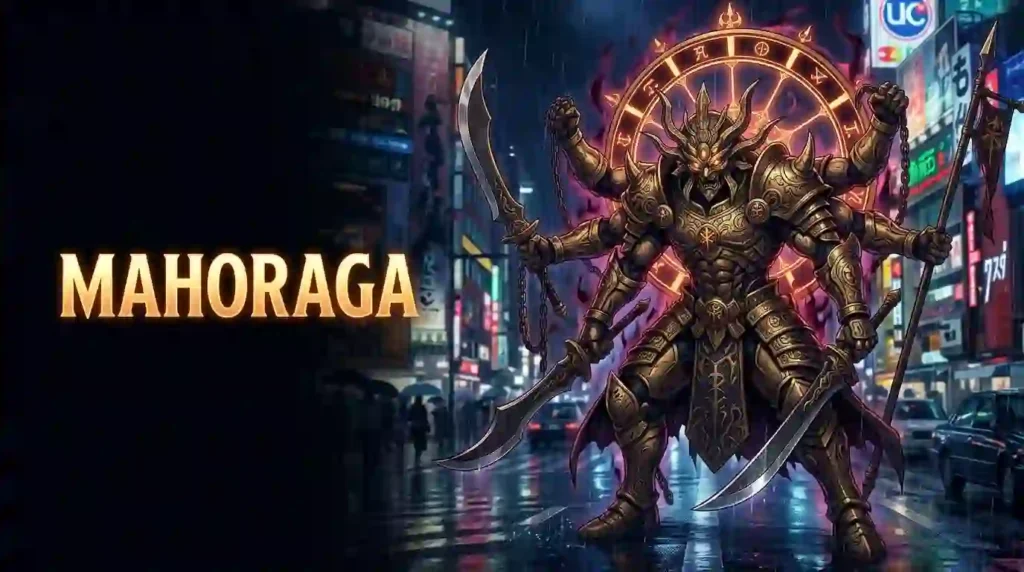
Mahoraga is a shikigami in Jujutsu Kaisen, a shadow-born combat construct. Megumi Fushiguro calls it out through his Ten Shadows Technique. The shikigami rises as a towering, eight-armed warrior in gold-bronze armor, with eight eyes and a segmented wheel fixed to its back.
One ability makes it stand out in the entire series: it adapts. Hit by a move once, and its body rewrites itself so the same move never lands again. That single rule makes it the scariest defensive force in the Shibuya Incident arc, and it is the reason the name still trends on fan forums today.
Five sentences summarizing what you should know:
- Type: shikigami, summoned by a named technique, not a basic call.
- Full technique name: the Divine General Mahoraga.
- Core rule: one hit, one adaptation, immunity to that attack type.
- The catch: the wheel is finite. A full rotation erases every recorded defense.
- Proof of record: it lost to a human with zero cursed energy.
The Real War God Behind the Name
The name is older than the anime by many centuries. Mahoraga traces to Sanskrit, where scholars read it as maharaga, often glossed as “great king.” The deity sits among the Eight Great Asura Kings, a group of powerful protector gods in East Asian Buddhist iconography [3].
Temple artists painted the god with eight arms to show command of every direction and every weapon. The image spread through China and Japan, and monks kept the design in altars and sutra paintings for generations.
Gege Akutami leans on that history on purpose. The shikigami keeps the eight arms, the war-god bearing, and a back wheel that echoes the dharma wheels in the deity’s artwork. The series never needs a lecture about the connection. The design is the lecture.
If you want to see the original images, Buddhist art archives and museum collections hold the oldest known panels of the eight-armed god. Comparing them to the manga page takes about two minutes, and it makes the character land harder.
How Megumi Summons Mahoraga
Megumi’s power is the Ten Shadows Technique, a hereditary art of the Fushiguro bloodline. Day to day he treats it as a summoning game: Nue, the chimeric beast, and Tojin, the war dog, step out of his shadow to trade blows.
The eight-armed giant is a different tier. It is not pulled from the shadow garden like the others. It is a complete shikigami art named the Divine General Mahoraga, and the art itself builds the body inside his shadow, one piece at a time.
Here is how the summoning unfolds:
- Megumi anchors his cursed energy in the shadow and stabilizes it.
- He activates the named shikigami art, not a basic summon.
- He speaks the technique’s title aloud — the summoning chant.
- The frame assembles out of shadow: armor first, then the eight eyes, then the wheel.
The cost is real. Running the art drains his cursed energy far faster than any other move he owns, so the giant lasts only as long as Megumi can keep fueling it. In Shibuya, that limit is the whole tension of the scene. Nobody knows if he can call it a second time while the first call is still burning.
What Does Megumi Say to Summon Mahoraga?
The chant is the technique’s name, spoken with intent. Megumi calls out the title — the divine general, then the name — to carve the shikigami out of his shadow [1]. The manga prints the full incantation in Japanese inside the technique panel, and the anime gives it an English dub line in the Season 2 broadcast [2].
There is no hidden magic word beyond the title. The structure fans transcribe is simple:
- A call of rank: the divine general.
- The name, spoken as a binding phrase.
- The shadow opens, and the frame assembles.
The hard part is delivery, not memorization. A user’s cursed energy has to stay clean and committed while he speaks, or the form comes out wrong. That is why the moment lands so hard on screen. He is saying a name, and the name is a machine.
If you want the exact wording, watch the Shibuya Incident chapters of the manga or the corresponding Season 2 episodes. The line first appears there, and both the English dub and the subtitles carry it clearly.
The Wheel on Its Back: How Adaptation Works
The wheel is the memory. Every segment records one attack type the body has already survived. When the same kind of damage comes again — a cursed-energy slash, a blunt strike, a projectile — the matching segment is filled, and the body shrugs the hit off.
Every new kind of hit advances the wheel one segment. Here is the part most summaries get wrong: the wheel is finite. When it completes a full rotation, the recorded defenses reset. The giant forgets what it learned and starts fresh.
Think of it as a short list with a delete button:
- Segment one: adapts to cursed-energy slashes.
- Segment two: adapts to blunt physical damage.
- Segment three: adapts to fire-based attacks.
- Full rotation: all three defenses clear, and the list restarts at zero.
What the adaptation is not also matters. It is not foresight. It does not predict the next hit, and the first instance of a new type always lands. It is a reaction, not a prediction, and that distinction decides the fight.
The reset is not a flaw. It is the opening. Any fighter who can out-rotate the wheel has a way through, and the manga goes on to prove the point with one of its most famous battles.
The Mahoraga Modulo: The Math Behind the Cycle
Power-scaling forums call this the modulo trick, and the name fits. The wheel behaves like a counter that wraps around: after the last segment, the next turn lands back on the first.
If you track which attack type sits on which segment, you can predict exactly when a defense expires. Strike with that type in the slot right after the reset, and the hit lands clean. No power-up needed. Bookkeeping.
The Toji fight runs on exactly this logic. He swaps attack types on purpose — slash, blunt force, cursed-spirit pressure — to keep the wheel turning. When it wraps around, he knows which defenses just cleared.
One honest note on precision: the manga shows the wheel turning but never spells out the segment count in dialogue. The reset on full rotation is the canon rule. The segment count is a visual detail fans model when they replay the fight, and any “exact number” you see online is a model, not a quote.
Stats and Abilities at a Glance
This table is your cheat sheet for the whole character.
| Attribute | Detail |
|---|---|
| Full name | Mahoraga, the shikigami; the Divine General Mahoraga, the summoning art |
| User | Megumi Fushiguro |
| Lineage | Fushiguro bloodline, Ten Shadows Technique; originally a shikigami of Ryomen Sukuna |
| Design | Eight arms, eight eyes, gold-bronze armor, segmented wheel on the back |
| Core ability | Auto-adapts to any attack type it has survived once |
| Cycle | Wheel advances one segment per adaptation; full rotation resets all defenses |
| Durability | Withstands repeated hits from elite fighters, including a human with no cursed energy |
| Offense | Heavy multi-limb strikes; brute force, not ranged pressure |
| First major fight | Toji Fushiguro, Shibuya Incident arc |
| Anime debut | Jujutsu Kaisen Season 2 (Shibuya Incident) |
| Series run | Jujutsu Kaisen, 2018–2024 (manga completed) |
Read the table top to bottom and a pattern shows up. It is built to outlast, not to outstrike. The offense is heavy, multi-armed force, and the wheel is the whole design.
The weaknesses, written plainly:
- Finite memory: a full rotation erases every adaptation.
- It must absorb the first hit of each new type before the immunity exists.
- No stated regeneration: the defense is immunity, not healing. Damage still accumulates.
- Tied to the caster: when Megumi’s cursed energy runs out, the giant does too.
- No ranged signature move: it fights at close to mid range with its own arms.
How Toji Fushiguro Defeated It: The Fight That Broke the Reputation
The Shibuya arc hands Mahoraga to Toji Fushiguro, and the matchup looks rigged against him. Toji is a former special-grade sorcerer who has no cursed energy left. The giant adapts to everything. And yet.
The sequence reads like a puzzle:
- Toji attacks with variety. He rotates cursed tools, hand-to-hand strikes, and his Cursed Spirit Manipulation so no single type repeats while the wheel still remembers it.
- The wheel fills. Each new type gets a segment, and the wheel keeps turning.
- The rotation completes. The recorded defenses reset, and the giant forgets the attacks that already beat it.
- Toji re-strikes the forgotten types. The hits land, and the armor that shrugged everything off finally starts to fail.
The scene works because nobody is stronger than anybody else. One man simply reads the system better. That is why readers still dissect the panel order two years after the arc closed.
Remember the bigger point. The shikigami adapted to every attack in the fight. It lost anyway. The adaptation is real, but it is not permanent. That sentence is the difference between a casual fan and someone who actually understands the character, and it reshapes every other matchup you will ever see it in.
Sukuna and His Own Shikigami: A Fair Fight?
The shikigami belongs to a lineage that starts with Ryomen Sukuna. So the natural question is what happens when the king meets the general that line created. Type “Sukuna vs Mahoraga” and you get a thousand fan votes, but the series never stages the match.
The power gap is not close. Sukuna is the strongest fighter in the series by a wide margin, and his Dismantle and Cleave slashes arrive with enough variety to keep the wheel turning fast. On pure power, the debate ends quickly.
The interesting part is control. A shikigami only exists while its technique is running. If the king meets the general on his own terms — his domain, his pace, his timing — he can end the art before the wheel finishes a second rotation.
So what changes if the fight happens inside Megumi’s Chimera Shadow Garden instead? The domain layers in Nue and Tojin, which adds two more attack types to the wheel’s to-do list. It slows the reset, it does not stop it. The fair read stays the same: Sukuna wins, and the real question is how much of the wheel he lets spin first.
The Crossover Question: Mahoraga vs Dabura
This section is fan territory, and it is labeled as such. Dabura is the red-mohawked warrior from Planet Sadala in Dragon Ball Z, a Super Saiyan in the future timeline who fought both Goku and Trunks. No official crossover exists, and neither series settles the question.
The case for Dabura is raw tempo. He fought a future Goku who was not at his peak and held his ground. In a match that ends in one or two clean hits, a faster, stronger fighter can close it before the wheel ever completes a turn.
The case for Mahoraga is the wheel itself. Adaptation does not care who swings. One ki blast lands and energy attacks are recorded. One punch lands and blunt force is recorded. And Dabura’s kit is strong but narrow — blasts and strikes. A narrow kit fills a finite wheel fast.
Most scaling debates land on the same note, and it is a fair one. Dabura wins if he ends the fight before two rotations. The shikigami wins if it survives long enough to remember his whole kit and answer with what he just forgot. Since neither series publishes hard numbers, any confident pick is opinion, not canon. Run the numbers yourself with the cycle rules from the modulo section above, and you can argue either side with evidence.
Which Characters Can Defeat Mahoraga?
The short answer: anyone who out-reads the wheel, or anyone whose power makes the wheel irrelevant. The manga proves one winner. The rest are defensible projections, and the table separates the two.
| Character | How they beat it | Canon or theory |
|---|---|---|
| Toji Fushiguro | Cycles attack types, forces a full rotation, re-strikes the forgotten defenses | Canon — Shibuya arc |
| Ryomen Sukuna | Outclasses it with power and variety; can end the technique on his own terms | Theory — never staged |
| Yuta Okkotsu | Cursed-energy output that dwarfs anything the wheel could have recorded | Theory |
| Satoru Gojo | Infinity keeps the hits from landing; no contact, no adaptation | Theory |
| Megumi Fushiguro, full kit | Runs the giant alongside Nue and Tojin inside Chimera Shadow Garden, layering attack types | Theory |
Two patterns stand out. The winners either manage the wheel like Toji or make the problem disappear. Characters who keep throwing one repeated attack type run into a wall that gets higher with every hit.
The practical takeaway for anyone writing their own theories: variety, speed, or nullification. Pick one and you have a path through. Pick none, and the wheel is the last thing you see.
Is There a Female Mahoraga?
No, and the series never assigns the shikigami a gender. The design is sharp and armored, and the anime gives it a deep voice, which is why most fans treat it as male. But the manga uses the name without a gendered form, and no official art, dialogue, or merchandise confirms a gender either way.
The “female Mahoraga” you see online is fan art and fan discussion, not canon. It is a popular redesign because the eight-armed silhouette reads well with feminine styling, and the version sells well as both wallpaper and figure concept art.
If official material ever adds a gendered or female version, this guide will note it here. As of the completed manga and every aired anime season, the shikigami stays gender-unspecified.
Key Takeaways
Before you leave, here is the whole character in five bullets:
- Mahoraga is a shikigami, not a shadow pet. It runs on a named technique with a real energy cost.
- The adaptation is one-hit immunity per attack type, tracked by the wheel on its back.
- The wheel is finite. A full rotation resets every defense it recorded.
- Toji Fushiguro is the only canon winner, and he won with bookkeeping, not power.
- Every other matchup on this page — Sukuna, Gojo, Dabura — is a labeled projection.
Design, Figures, and Wallpapers: Where to Get It Right
The silhouette is easy to recognize and hard to fake well. A tall armored frame, eight arms, eight eyes, gold-bronze plating, and the segmented wheel on the back. Get any of those wrong, and the piece stops reading as the character.
For figures, start with the licensed lines. Bandai runs the most active Jujutsu Kaisen figure catalog, and the shikigami appears across several scales, from small collectibles to display pieces and model kits. A “mahoraga figure” search covers all of them, so check the official Jujutsu Kaisen goods pages and the Bandai store for current releases before you pay for a third-party “unofficial” statue.
For wallpaper, the cleanest sources are the official Jujutsu Kaisen social accounts and the anime’s promotional art. Pull the image at 4K from those pages and you get the exact on-screen design with no fan-art drift. Search “mahoraga wallpaper” or “mahoraga jjk official art,” filter to official accounts first, and skip anything watermarked by a fan page. The “megumi mahoraga” pairing tag, by the way, pulls up some of the most shared fan art in the fandom, so know the difference between the two buckets when you shop.
Where to Watch the Debut
Mahoraga first appears on screen in Jujutsu Kaisen Season 2, which adapts the Shibuya Incident arc. The Toji fight lands in the second half of the season, and the eight-armed design carries the scene from its first step out of shadow to the wheel’s final turn [2].
If you only watch one arc for this character, it is Shibuya. Manga readers get the same material in the corresponding arc, with the chant and the wheel turns drawn panel by panel [1].
Watch with a pen and a circle next to each new attack type Toji uses. Count the wheel’s turns. By the final minute you will see exactly why the human won, and no summary can teach you that the way the panels can.
Frequently Asked Questions
What is Mahoraga in Jujutsu Kaisen?
Mahoraga is a shikigami that Megumi Fushiguro summons through the Ten Shadows Technique. It is an eight-armed, wheel-backed war construct that adapts to any attack it has survived once. The ability is real but finite: a full rotation of the wheel resets every defense it recorded, and that reset is what allowed Toji Fushiguro to win the Shibuya fight.
What does the Mahoraga wheel actually do?
The Mahoraga wheel is the adaptation tracker. Each segment records one attack type the body has already absorbed, and the same type is deflected afterward. When the wheel completes a full rotation, all recorded defenses reset and the tracking starts over. It is the character’s memory and its only exploitable flaw in one piece of hardware.
How did Toji defeat Mahoraga?
Toji defeated Mahoraga by changing attack types constantly — cursed tools, strikes, and his Cursed Spirit Manipulation — until the wheel completed a full rotation and its memories cleared. He then struck with an attack type it had already adapted to and just forgotten. The hits landed, the armor failed, and a man with zero cursed energy took down an adapting war god.
What does Megumi say to summon Mahoraga?
He speaks the technique’s title as a chant: the divine general, then the name. The manga prints the full incantation in Japanese, and the anime localizes it for the Season 2 broadcast. There is no extra magic word beyond the title itself, and the exact line first appears in the Shibuya Incident chapters.
Is Mahoraga male or female?
The series never gives Mahoraga a gender. Fans usually read the shikigami as male because of the armored design and the deep voice in the anime, but no official material confirms either answer. The female versions circulating online are fan art, not canon.
Who can beat Mahoraga in JJK?
In canon, Toji Fushiguro beat Mahoraga in the Shibuya arc, the only top-tier fight it lost. Beyond that, the defensible list is anyone who manages the wheel’s cycle and anyone whose power ignores it entirely. The table above ranks each option by how solid the case is, with canon and theory kept in separate columns.
Put the Wheel to Work
Now that you know how the wheel turns, go watch the Toji fight with a segment counter in hand. Mark each new attack type, watch the wheel complete its rotation, and see the reset happen with your own eyes. No summary teaches that beat the way the panels do.
Then pick a side and argue it in the comments. Is the crossover match a tempo fight or a bookkeeping fight? Does the reset make the shikigami the series’ best defensive design, or its most overrated one? The design section above is your canon checklist, and the table tells you which claims are proof and which are projection.
Share this guide with the friend who still thinks the adaptation is permanent. The reset is the whole story, and once you see it, you see the entire Shibuya arc differently.